Carl Jung Resources > Collective Unconscious
What is the Collective Unconscious According to Jung? The
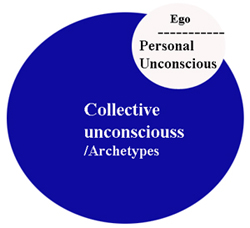
collective unconscious is a psychic layer made of archetypes. It is common to all human beings regardless of culture and existential plane. We find it anywhere and anytime. Also it is a hereditary datum that does not vary according to the level of intelligence, age, sex, etc.
One can not acquire it only by way of culture and education.
Archetypes are innate tendencies, equally universal, which determine, beyond human consciousness, the basic activities and their typical representations. -> Explore the archetypes pageWe find them in dreams and visions. That is why Jungian psychoanalysis pays special attention to the interpretation of dreams and symbols to discover clues related to the evolution of the cure.Finally, we can describe the collective unconscious as a universal library accessible to all people or the wise (spirit) within man. Jung stated that the religious life must be linked with the experience of the archetypes of the collective unconscious. Thus, God himself may be experienced like an archetype on the psychic, individual, level. What is an Example of Collective Unconscious?
People use to ask for an example of collective unconscious. Obviously there'as no such example. One can't find an example of collective unconscious just because this entity
doesn't exist as a material piece of something. It is not something one can see and touch. It is a concept closer to psychology or philosophy. It doesn't
have a concrete shape. It exists only on the thinking/thought plane. Jung's Quote about the Collective Unconscious The collective unconscious - so far as we can say anything about it at all - appears to consist of mythological motifs or primordial images, for which reason the myths of all nations are its real exponents. In fact, the whole of mythology could be taken as a sort of projection of the collective unconscious... We can therefore study the collective unconscious in two ways, either in mythology or in the analysis of the individual. (From The Structure of the Psyche, CW 8, par. 325.) Question: "What if I want to know more about the archetypes in dreams?"
Should you need to learn about archetypes in dreams, you may enroll in our email beginners-friendly course on Jungian dreams. -> Visit the course page Further Resources:
|

©AROPA, 2026